Rotational Focus Strategies
Does rotating your focus strategy daily help with ADHD? A mixed-methods study—and the app built to run it.
Overview
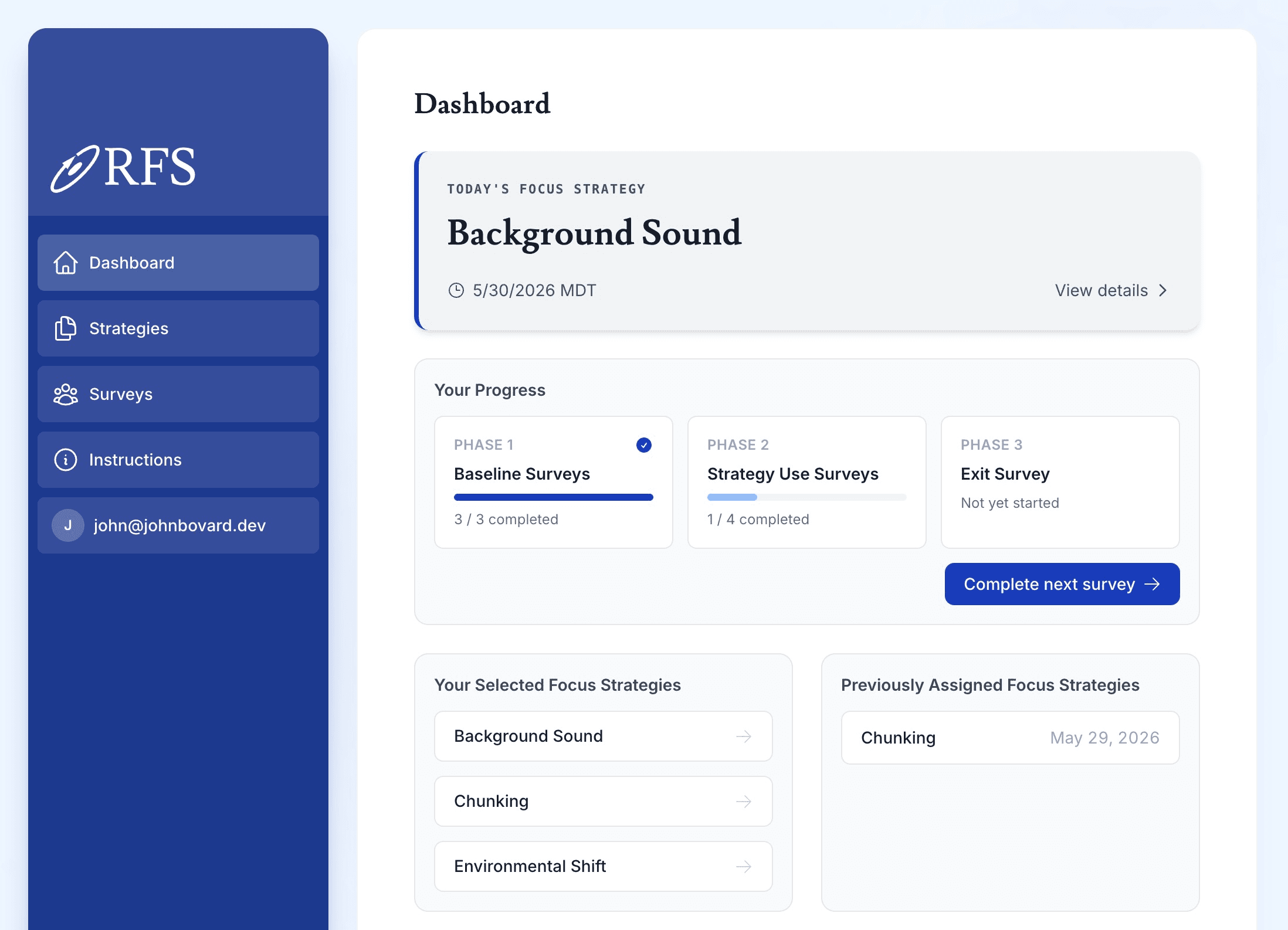
Focus strategies for ADHD work—until they don't. Novelty-seeking is a core ADHD trait, and strategies lose their effectiveness as they become routine. Grounded in Kovacs et al. (2018), which found that rotating behavioral interventions increases effectiveness, this project asked whether a lightweight app that randomly assigns a different focus strategy each day could improve perceived productivity and satisfaction for people with ADHD. I designed the study, built the app, ran the pilot, collected the data, and analyzed the results—solo, as a graduate course project.
The problem
Focus strategies—Pomodoro, chunking, environmental shifts, checklists—are effective ADHD management tools. The problem is adherence. Strategies lose novelty over time, and novelty-seeking is a defining trait of ADHD. People with ADHD aren't failing to try; they're running into a structural mismatch between how static interventions are designed and how ADHD brains respond to repetition.
Kovacs et al. (2018) found that rotating online behavior-change interventions increased effectiveness even as it increased attrition—a tradeoff worth examining for ADHD specifically. Could a lightweight app that randomly assigns a different focus strategy each day improve perceived productivity and satisfaction for people with ADHD?
My role & approach
The study was conducted as a solo graduate course project in Designing Digital Health Systems (Spring 2025), covering everything from literature review and study design through engineering, data collection, and analysis.
Designing for this population meant the app had to be genuinely low-friction—forgiving of missed days, usable across devices, and unobtrusive enough not to get in the way of what it was measuring. Those constraints shaped every technical and design decision downstream.
Process
The study drew on eight papers spanning ADHD prevalence and employment outcomes, novelty-seeking as a core ADHD trait, rotating behavior-change interventions, self-efficacy and productivity, and software engineers with ADHD. The Kovacs et al. finding was the theoretical anchor: rotation increases effectiveness, and the ADHD population's novelty-seeking disposition makes that effect worth testing directly.
Design constraints first, then stack
Before writing any code, I worked through what the app actually needed to be: platform-independent, low in daily demand, forgiving of forgetfulness, and simple enough not to confound what it was measuring.
Google Forms would have been faster to build. I ruled it out because randomized daily strategy assignment needs logic that static forms can't support, and I needed persistent user state across a multi-day study. A bad UX would have been a research problem, not just an engineering one.
I tested a paper prototype with two peers before committing to the build. The format couldn't simulate the multi-day structure, so findings were limited—but it confirmed the core interaction model and made clear that instructions needed to be more explicit about what was expected at each phase. With that settled, I finalized the stack: React, TypeScript, Next.js, PostgreSQL, Supabase, and Clerk Auth, deployed on Vercel. Once the stack decisions were made, implementation took about four days.
Piloting and iterating
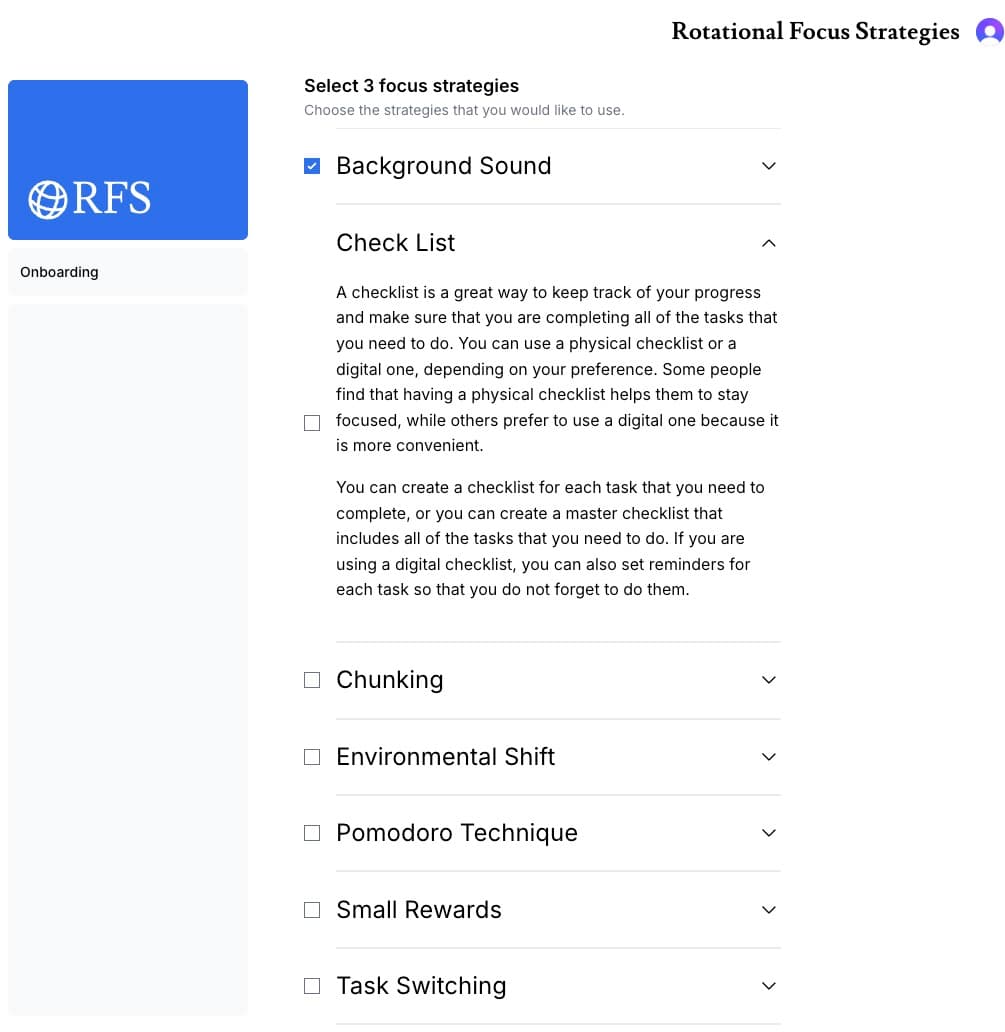
Before the main study I ran a digital pilot with three participants over three days—one diagnosed with ADHD, two self-reporting suspected ADHD. The sample was small and the window was short, but the pilot surfaced real problems. Database double-submissions from rapid clicks got fixed by disabling the submit button after the first click. Users had no way to see what strategy they'd previously been assigned, so I added assignment history to the dashboard. Instructions were unclear about which survey to complete and when, which I addressed with phase-specific accordion sections. The exit survey was being skipped entirely because it looked identical to the daily survey, so I distinguished its appearance.
One participant wanted to select their own strategy each day rather than have one randomly assigned. After we talked it through, it was clear they didn't have strong feelings about it—and allowing self-selection would have undermined the novelty mechanism the study was built around. Random assignment stayed.
Study design
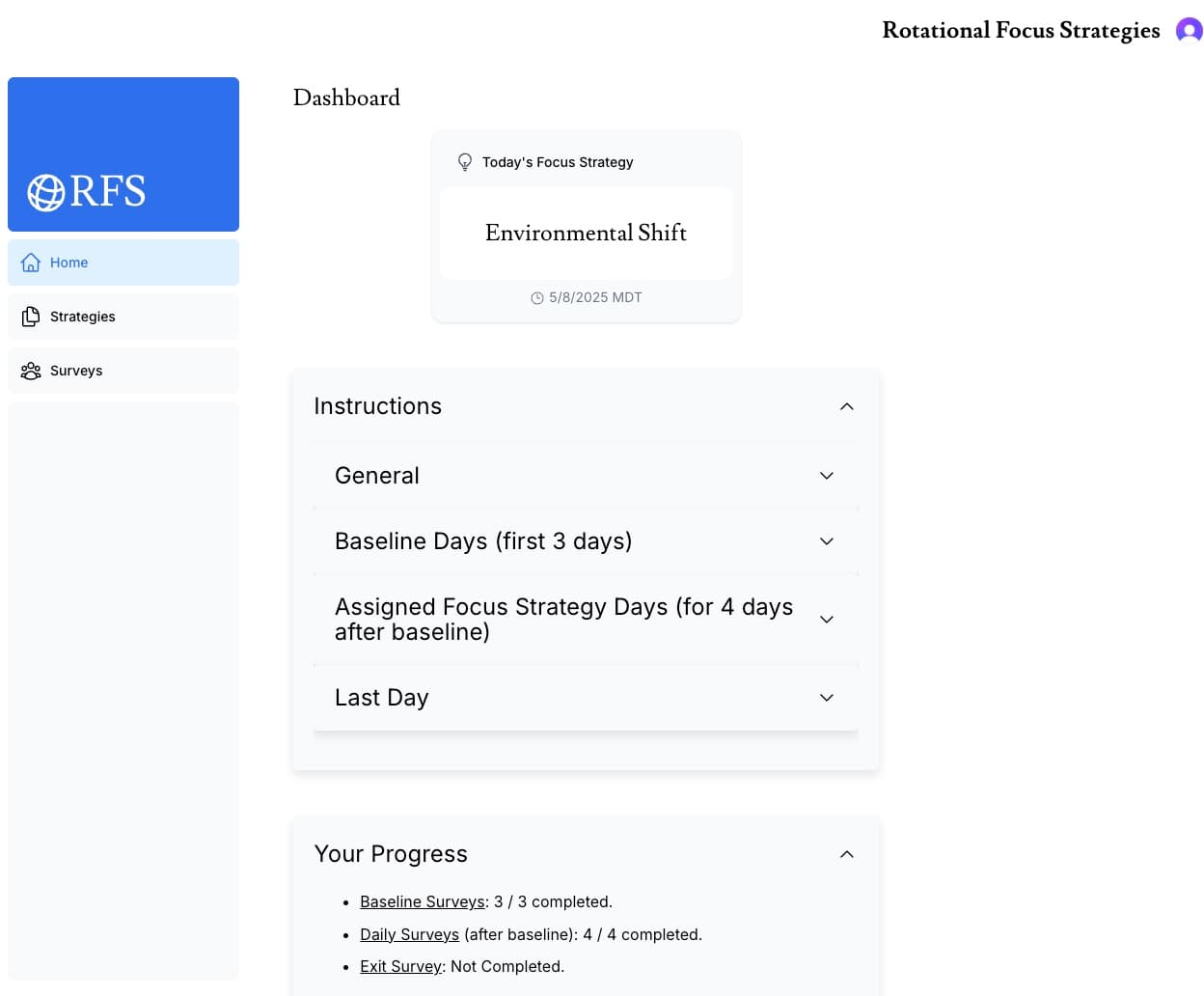
The main study ran for seven days per participant: three baseline days of end-of-day Likert surveys on satisfaction and productivity, followed by four days of randomly assigned focus strategy use, with an exit survey on the final day.
Recruitment was via convenience and snowball sampling—ADHD forums require IRB approval, so I reached out through personal networks. Seven participants enrolled; three completed more than 80% of surveys (P1, P3, P5) and were included in the primary analysis. Analysis combined Pearson's correlation on Likert responses with thematic analysis of open-ended daily and exit survey responses.
Outcome & results
Quantitative findings
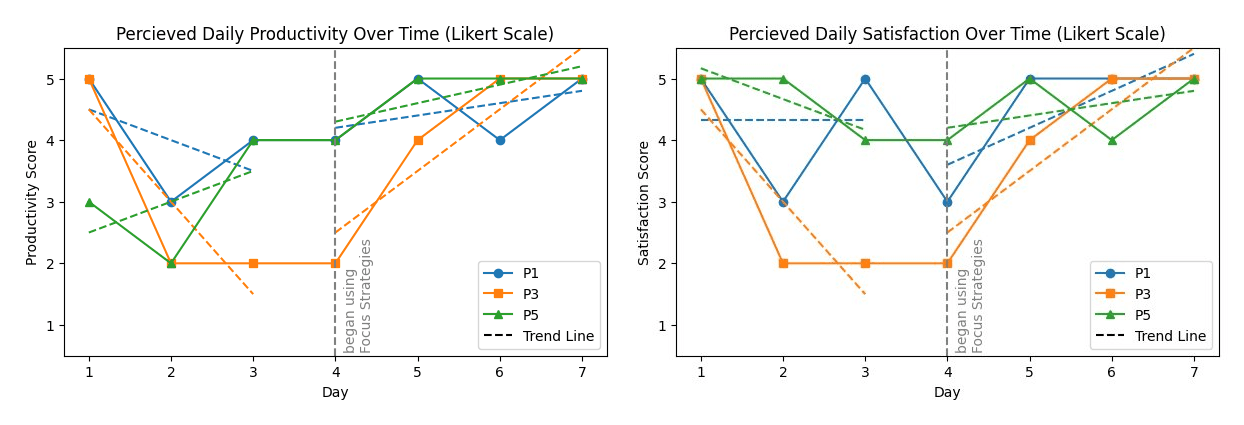
Among participants with more than 80% completion, mean satisfaction scores rose from 4.0 at baseline to 4.33 during focus strategy days. Mean productivity scores rose from 3.33 to 4.25.
Pearson's r for focus strategy use and daily productivity was 0.38, a weak positive correlation. For satisfaction, r = 0.079, which falls below the threshold for even a weak correlation by standard benchmarks. With only three participants in the primary analysis, neither result is conclusive. The directional signal is consistent, but this is a pilot study, not a proof.
Thematic findings
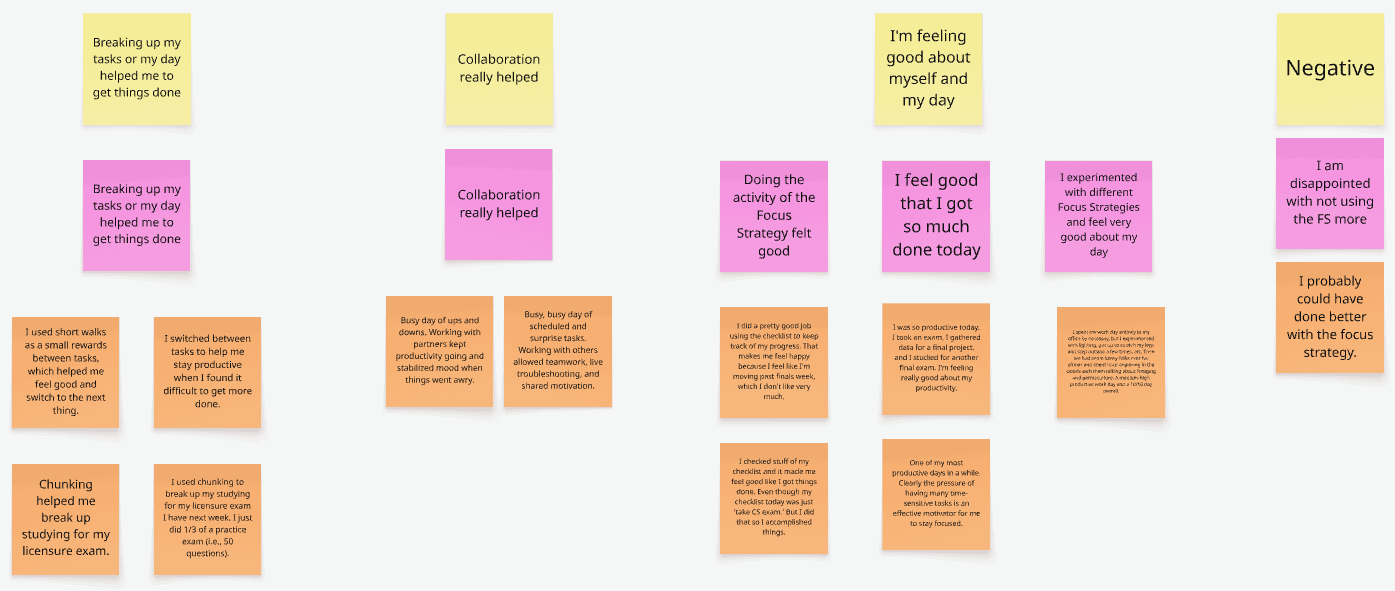
Thematic analysis of 12 open responses surfaced six themes. Breaking up tasks or the day to aid completion was the strongest (n=4)—participants described chunking and task-switching as concrete mechanisms behind their better days, not just general positivity about the app. One participant noted that rotating between strategies correlated with their best day of the study, which is about as direct a confirmation of the Kovacs et al. hypothesis as you can get from a single data point.
The more interesting finding came from the exit surveys. One participant wrote:
"Even if I was not employing the strategy at the particular time, reminding myself that I HAD a focus strategy for the day was helpful."
That suggests a self-efficacy effect that operates independently of whether the strategy is actually used—having a plan improved how people felt about their day even when the plan wasn't followed. A second participant said they wanted to keep journaling and monitoring their productivity after the study ended, which suggests the intervention produced some behavior change beyond the study window.
Reflection
The biggest lesson from this project was about scope discipline. Building a full-stack web application was the right choice—a form-based alternative couldn't have supported randomized daily assignment, and offloading that randomization to the app meaningfully reduced participant burden (no rolling dice, no remembering which strategy to use). The flexibility to submit surveys late was equally important for an ADHD population where rigid daily deadlines would have increased dropout. The tradeoff was time: development consumed more than it should have, leaving less room for piloting and a shorter study window than I would have liked.
The dropout rate was anticipated—longitudinal studies with ADHD populations have known retention challenges—but four of seven participants completing fewer than 80% of surveys still limited what could be concluded. A follow-up study with better retention mechanisms, whether push notifications, shorter surveys, or a buddy system, would be worth running.
What I'd preserve: the decision to keep random assignment despite a participant's preference to self-select. Accommodating that request would have undermined the mechanism the study was testing. Knowing when a design decision is a constraint worth holding is as much a research skill as an engineering one.
After the course
The class ended, but I kept building. Over the following months I took RFS from a graded project to a maintained, production-hardened app—partly because the original build had accumulated design debt I didn't have time to address under the course deadline, and partly because I wanted to see what the project looked like held to a real production standard instead of a semester one.
Accessibility. I conducted a WCAG AAA audit across every page—landing, auth, onboarding, dashboard, and surveys. That meant re-checking
every text/background color pairing for contrast (dropping anything that
only cleared AA), adding proper focus management across multi-step forms
so focus doesn't get stranded on a hidden input after a step transitions,
skip links on every layout, and live regions for things like Caps Lock
warnings and validation errors that were previously silent or handled
with a browser alert(). Survey forms got proper <fieldset>/<legend>
grouping for screen readers. This is also where the "Accessibility" tag
on this case study earns its keep—it wasn't a checkbox during the
study, it's now a property of the deployed app.
Row Level Security. The original study used Clerk for authentication but hadn't fully implemented Supabase's Row Level Security—I'd documented the constraints but shipped with an application-level workaround. Post-course, I went back and finished it: Clerk JWTs are injected as Supabase access tokens, and RLS policies enforce per-user data isolation at the database level instead of in application code.
PWA and push notifications. Retention was one of the study's real limitations—four of seven participants completed under 80% of surveys. I added a service worker, offline fallback, and scheduled Web Push reminders (with timezone-aware delivery) as the fix I'd propose if I ran this again.
Everything else. A full visual redesign unifying the design language across every page, a rebuilt landing page for people encountering the project outside the study (like you, right now), parallelized data fetching and caching to cut down redundant database calls, and major version upgrades across the stack (Next.js 16, React 19.2, Tailwind CSS 4, Clerk 7).
The app is still live and running at focusapp.dev.